

A recent article in The Straits Times, on why Singapore parents remain stressed despite efforts to ease academic pressure, caught my attention. Even as Singapore continues to talk about reducing academic pressure, many parents remain anxious about their children's education and future. I understand this tension.
Most parents do not want to overload their children, yet many still feel uneasy if they are not doing enough. We say that grades are not everything, but when the future feels uncertain, it is natural to wonder if our children are being left behind. Perhaps that is why tuition has become such a common response to parental anxiety.
It gives us the feeling that we are doing something practical to help. But I sometimes wonder if there is a bigger question we should ask ourselves. Are we preparing our children only for examinations, or are we preparing them for life?
When children choose differently
As a father of three grown-up children, I have had my share of moments when their decisions about education and future careers were different from what I might have expected. At various stages of their lives, they had good opportunities available to them. Yet, rather than simply following what appeared to be the more conventional or promising path, they sometimes chose other possibilities.
Some wanted more time to consider their direction. Others preferred an educational pathway or area of study that better reflected their own interests and aspirations. Did I have concerns?
Of course. Like any parent, I wanted the best for them. There were moments when I wondered whether the opportunities before them were too good to pass up.
But I also reminded myself that these were their lives to live, not mine. My responsibility was to discuss the possibilities with them, help them think through the consequences, ask questions and offer my perspective. The final decision, however, had to be theirs.
Looking back, I am glad I gave them that space. Not simply because things eventually worked out well, but because they learned something far more valuable along the way: how to take ownership of their decisions and have the courage to follow a path they believed in.
Learning when to hand over responsibility
Those experiences taught me something about parenting that I appreciate more deeply today. When our children are young, we make most of the decisions for them. We choose their schools, plan their activities, guide their learning and try to protect them from making mistakes.
It is part of our responsibility as parents. But as they grow older, our role must gradually change. We still have a responsibility to teach values, build character and help them develop good judgment.
These are foundations that begin at home and cannot simply be left to schools or tuition centres. At the same time, our children need opportunities to make their own choices, weigh the consequences and learn to take responsibility for the outcomes. The responsibility of parenting does not disappear as our children grow.
It changes from making decisions for them to preparing them to make decisions for themselves.
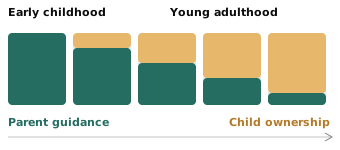
I find this easier to understand in hindsight than it was to practise when my children were younger. We want our children to think independently. Yet when they start making decisions that differ from ours, we sometimes struggle to accept them.
Perhaps that is because letting go requires trust, not just in our children, but also in the values and judgment we have spent years helping them develop. And in a world that is becoming increasingly unpredictable, that ability to think and decide for themselves may be one of the most valuable things we can give them.
Preparing children for a world we cannot predict
The world our children are entering is changing faster than many of us could have imagined. Technology is transforming industries, careers are evolving, and opportunities that seem promising today may look very different tomorrow. We cannot possibly predict every challenge our children will face.
So rather than trying to make every decision for them, perhaps we should focus more on developing the qualities that will help them make good decisions for themselves. We can teach them values, encourage curiosity, develop their reasoning and analytical thinking, and help them build resilience and responsibility. These lessons are not taught mainly through worksheets, grades or enrichment schedules.
They are often taught quietly at home, through daily conversations, family habits and the way we respond to life's challenges. Sometimes that means resisting the urge to provide every answer. Sometimes it means listening more than lecturing.
Sometimes it means allowing children to struggle a little, so that they can learn how to recover. Our role is not just to clear the path for our children. It is to prepare them to walk their own paths.
Learning goes beyond the classroom
Having spent many years teaching children, I have come to realise that academic progress is only one part of their development.
Of course, a good education matters. Children need knowledge, guidance and support when they struggle. But learning should also help them become curious, think independently and develop the confidence to work through challenges.
These are qualities I value both as a father and as an educator.
Sometimes, helping a child means explaining a difficult concept patiently. At other times, it means resisting the temptation to provide the answer immediately and allowing the child to think through the problem.
And perhaps that is where parenting and education share a common purpose. We are not simply preparing children to give the right answers today. We are helping them develop the confidence and judgment to find their own answers tomorrow.
Learning to guide, and then let go
Parenting will probably always come with some anxiety. We care too much not to worry. But perhaps we can remind ourselves that our children do not need parents who control every outcome.
They need parents who provide a strong foundation, offer wise guidance and trust them enough to grow. We may not always agree with the decisions they make. Sometimes they may turn away from options that seem attractive to us.
At other times, they may take longer than we would like to find their way. Still, if we want our children to become responsible adults, we must gradually allow them to own their choices. As I look at my children today, I realise that one of the most satisfying parts of parenting is not seeing them follow the exact paths I imagined for them.
It is seeing them find the confidence to choose their own paths. We cannot guarantee our children's results, careers or future success. But we can give them something that may matter even more: sound values, strength of character, the ability to think and the courage to take responsibility for their own lives.
Perhaps our job is not to prepare a perfect path for our children, but to prepare our children to walk their own paths. Written by Mr Lim, AZKEN
Mr Lim
AZKEN Learning Centre
- Teaching Mathematics & Science since 2010
- Founder of AZKEN
- Primary Science, Primary Mathematics and Secondary Mathematics educator
With over a decade of experience teaching Science and Mathematics in Singapore, Mr Ken Lim has helped hundreds of students build confidence and achieve their academic goals. He believes every child can excel with the right guidance and encouragement.