
“My child understands the Science concepts, but somehow keeps losing marks in open-ended questions.”
This is a concern I often hear from parents. Naturally, the response is to encourage their children to practise more examination papers, study model answers and remember important scientific keywords.
While these practices have their merits, perhaps we should also examine how our children approach Science questions in the first place.
Knowing a scientific concept and being able to apply it to explain an observation are two different skills. Learning from model answers provides a valuable foundation, but students must also develop the ability to apply their knowledge in unfamiliar contexts.
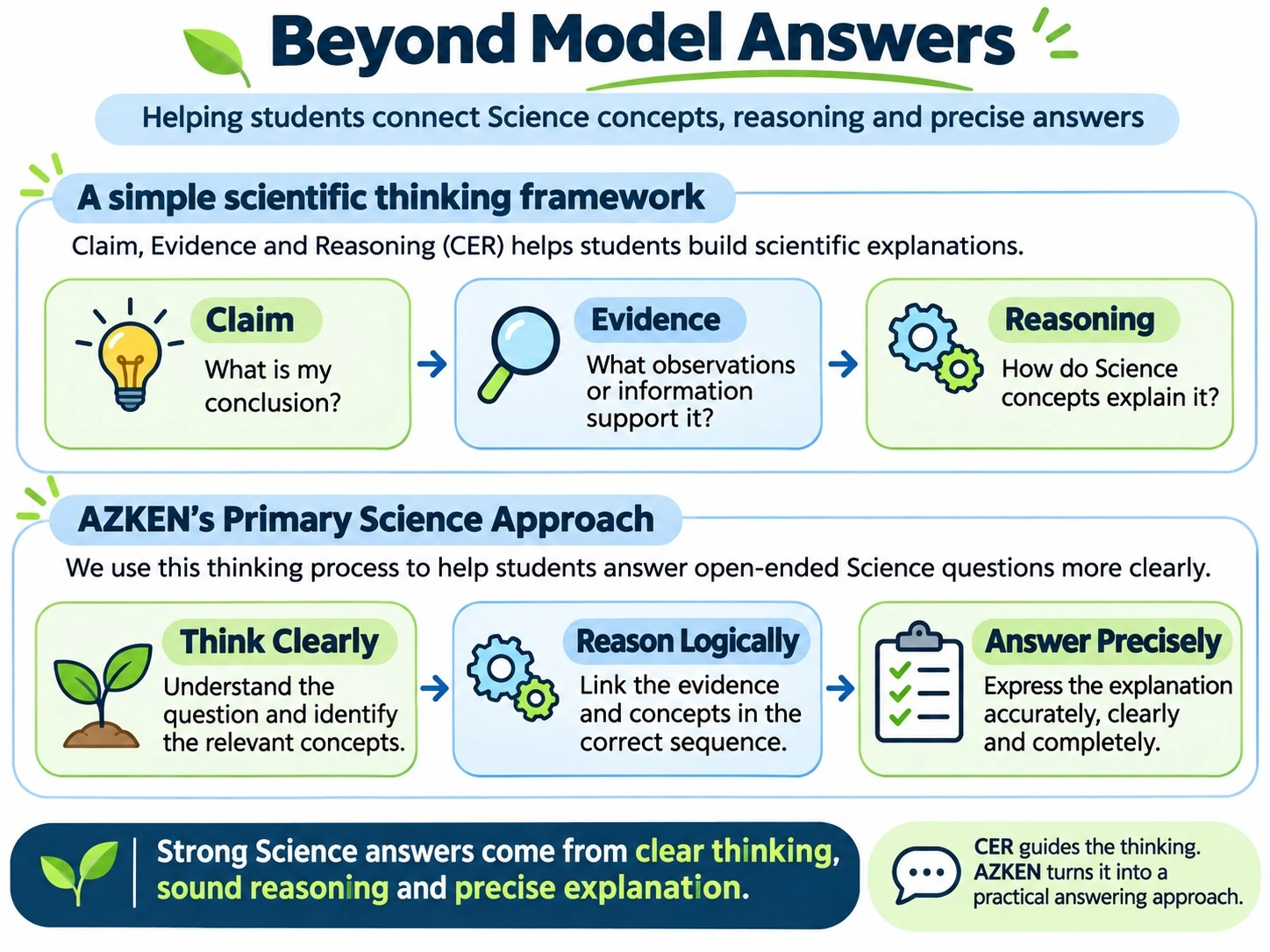
One approach to developing this ability is the Claim, Evidence and Reasoning (CER) framework, which encourages students to construct scientific explanations through three key elements:
- Claim: What is the answer or conclusion?
- Evidence: What observations or information support the claim?
- Reasoning: How do scientific concepts explain the relationship between the evidence and the claim?
Consider an experiment where the food-carrying tubes in a plant's stem are removed. A bulge subsequently forms above the cut.
A student may understand that food cannot be transported downwards, but the explanation is incomplete without establishing that food accumulates above the cut, causing the bulge.
It is this missing scientific link, rather than a lack of content knowledge, that may cost the student a mark.
Drawing on the principles of CER, we at AZKEN are continually refining our approach to teaching Primary Science, placing greater emphasis on three fundamental principles:
Think clearly. Understand what the question is asking and identify the relevant scientific concepts.
Reason logically. Connect the evidence with the scientific concepts to establish a logical explanation.
Answer precisely. Communicate the explanation accurately and completely, without unnecessary information.
Building on a strong foundation of scientific knowledge, we aim to develop students who can apply what they have learnt, reason independently and express their understanding with confidence and precision.
Ultimately, mastering Science is about connecting what we know with what we observe, and being able to explain why.