
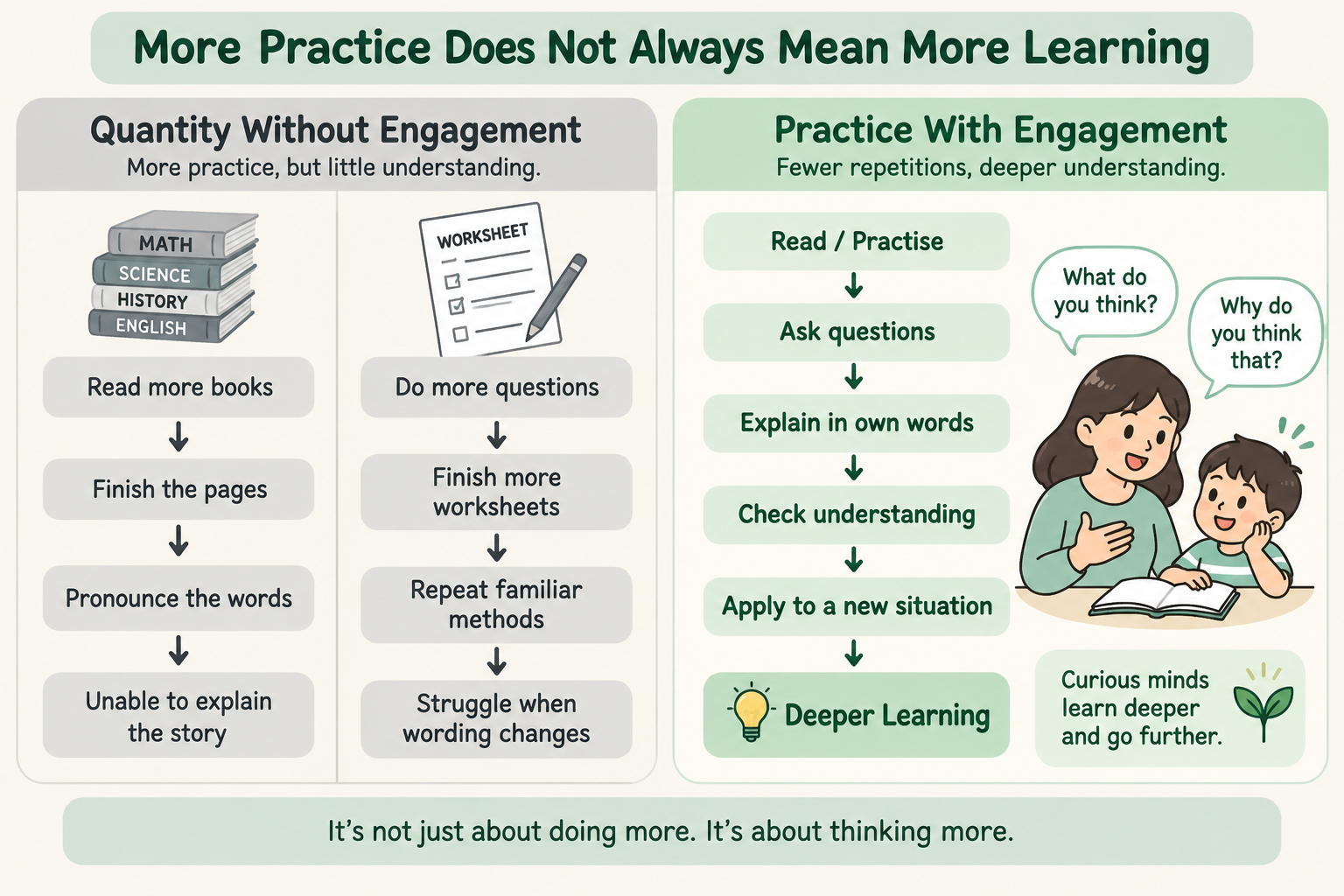
"Your English is weak. Read more books." "Your Maths is weak. Go and practise more questions." Many Singapore parents have said something like this, and almost always for the right reason: they want their child to improve, and with busy work schedules, extra practice feels like the most practical help they can give. Reading and practice are both important. But more practice does not automatically lead to better learning.
What the child may be feeling
Picture it from the child's side. They sit at the table with a book or a stack of Maths worksheets, while the rest of the family watches television, scrolls on their phones or does something they enjoy. Some children start to quietly think: "Why am I being punished while everyone else gets to relax?"
The issue is not the book or the worksheet. The issue is whether the child is learning from the activity, or simply completing it because a parent asked them to.
Reading fluently is not the same as reading with understanding
So if the book is not the problem, what is? It helps to separate two things that can look identical from the outside. Some children proudly tell their parents that they have finished many books. They really did read them. They may even read aloud clearly and pronounce almost every word correctly. But when we ask a few simple questions, the picture can change:
- "What was the story about?"
- "Why did the character do that?"
- "What happened at the end?"
- "What do you think the author was trying to tell us?"
Some children struggle to answer. They have learned to decode and pronounce the words, but may not have thought deeply about what they read. This does not mean every fast reader has weak comprehension. It is simply something worth gently observing.
Reading aloud fluently and reading with comprehension are related skills, but they are not the same thing.
"My child speaks English well. Why can't they understand Maths word problems?"
The same gap does not stay in English. It follows children straight into Maths word problems, and this is one of the most common questions parents ask me. Conversational English and academic comprehension are different. A child may chat confidently with adults, yet still find it hard to:
- Understand long sentences with several conditions.
- Identify the important information.
- Understand words with a specific mathematical meaning, such as "remaining", "each" or "more than".
- Separate useful information from distracting information.
- Work out what the question is actually asking.
- Turn written information into mathematical relationships.
- Explain the problem in their own words.
In my Primary Maths classes, I often see a child get stuck on a problem sum, and then solve it in under a minute once someone explains what the question means. The calculation was never the problem. The real difficulty was comprehending and interpreting the question before doing the Mathematics. This is not the cause for every child, but it is one possibility parents and teachers should look out for. It is also why checking the question matters so much, as I explain in our guide to avoiding careless mistakes in Math.
Completion versus understanding
Put the reading gap and the word-problem gap side by side and they point to the same root: is your child completing the task, or understanding it? The difference is easy to state:
- Task completion: "I finished 30 questions." Learning: "I understand why this method works."
- Reading completion: "I finished three books this week." Reading comprehension: "I can explain what happened, why it happened and what I learned from the story."
Quantity can be useful. But quantity without reflection, feedback or understanding can create an illusion of progress: lots of pages done, very little that sticks when the question is worded differently.
Ten minutes of the right questions
All of this raises a fair question: if discussion and understanding matter so much, where does a busy parent find the time? The answer takes less time than most parents expect. Younger children usually need some guidance, but that does not mean sitting beside your child for two hours every evening. Even 10 to 15 minutes of meaningful conversation can change the experience completely.
For reading, you could occasionally ask:
- "What happened in the chapter?"
- "Which character did you like?"
- "Why did he do that?"
- "What do you think will happen next?"
- "If you were the character, what would you do?"
For Maths, instead of asking your child to solve the question straight away, try:
- "Tell me what this question is saying."
- "What information did they give you?"
- "What are we trying to find?"
- "Can you draw it?"
- "What do you think the first step should be?"
In my experience, the best ten-minute sessions rarely happen at a study desk. They happen over dinner. Chatting with children at the dinner table, I have noticed that a simple question like 'what happened in school today?' opens the door. Children come across tricky questions in school, and they like to share them, especially the one that stumped the whole class or made everyone laugh. Let them tell it in their own words. Then ask what the question was really asking, or what they tried first. The chat often stretches by itself into how to solve the question together, with no worksheet in sight.
Something bigger is happening in those ten minutes. The child feels heard, so it becomes bonding rather than another task on the list. And explaining a tricky question out loud, from start to finish, in their own words, is itself the skill we are aiming for. It builds the confidence to explain and elaborate, which is exactly what Science open-ended questions reward later on: a child who can narrate what happened, why it happened and in what order at the dinner table is rehearsing the same ability PSLE Science marks depend on.
The goal is the same, whether at the dinner table or the study desk: get your child to think aloud, rather than simply produce an answer.
When learning starts to feel like punishment
Of course, none of this works if the extra work itself has turned into something the child dreads. When extra reading or worksheets are given mainly after a poor test result, some children begin to link the two: poor results means more work, and more work feels like punishment. Over time, reading and Maths practice themselves can start to feel like punishment.
Try to replace "You did badly, so do more" with "You don't understand this yet, so let's work out what you're missing."
Supportive language keeps learning about curiosity rather than fear, and children who are not afraid of mistakes are far more willing to explain their thinking.
A better approach: Practice, Discuss, Understand, Apply
So what does the healthier version look like? Not a longer checklist, but a different order of events. In our classes it comes down to a simple four-step cycle that any family can copy at home:
The four-step learning cycle
Practice: your child attempts the reading or Maths activity.
Discuss: a parent, teacher or tutor asks questions about what your child understood.
Understand: your child explains the idea in their own words.
Apply: your child uses the idea in a new question, situation or example.
Repeating this cycle is often more meaningful than simply adding more books or worksheets. It is also how we teach at AZKEN: in our small-group Primary Maths and Science classes, students are regularly asked to explain their thinking out loud, so gaps in understanding show up early instead of during the exam. Small groups make this possible, which I explain further in why small group tuition works.
If you would like to see how this works for your child, you can view our class schedule or read what other parents say in our parent reviews. Questions? WhatsApp us at 8166 1212.
Frequently Asked Questions
My child reads a lot. Why is their English comprehension still weak?
Reading fluently and understanding deeply are different skills. Ask a few questions after each chapter, such as what happened and why a character acted that way. If your child struggles to answer, the reading may be more about finishing pages than thinking about the story.
Why does my child understand Maths but struggle with word problems?
Sometimes the difficulty is not the calculation but understanding the question: long sentences, key words with mathematical meanings, and distracting information. Asking your child to retell the question in their own words often shows where the confusion is.
How much time should I spend helping my child each day?
Even 10 to 15 minutes of meaningful conversation helps, and it does not need a desk. Some of the best sessions happen over dinner, when a child shares a tricky question from school and you ask a few good questions about it. You do not need to sit beside your child for hours.
Is doing more worksheets bad for my child?
No. Practice is important. It works best when it is followed by discussion and a chance to explain and apply the idea, so the child is learning from the worksheet rather than just completing it.
Want personalised guidance for your child?
Every student learns differently. At AZKEN, Mr Ken Lim designs personalised learning plans that address your child's specific needs and goals.
Mr Ken Lim
Founder & Lead Educator, AZKEN
- Teaching Mathematics & Science since 2010
- Founder of AZKEN
- Primary Science, Primary Mathematics and Secondary Mathematics educator
With over a decade of experience teaching Science and Mathematics in Singapore, Mr Ken Lim has helped hundreds of students build confidence and achieve their academic goals. He believes every child can excel with the right guidance and encouragement.