
Your teenager comes home, drops their bag and shuts the bedroom door. Something happened, perhaps a disappointing test result, a falling-out with a friend, or a comment from a teacher, but when you ask, the answer is "Nothing lah" or "I'm fine." The parent instinct fires immediately: fix it. Give advice. Tell them exactly what to do. After more than a decade of teaching teenagers, I have learned something that took me far too long to understand: sometimes what a teenager needs most is not a solution. It is an audience.
Why the urge to fix can backfire
It comes from love. We see our child struggling, we can see the answer, and standing by while they flounder feels almost unbearable. So we advise. But from the teenager's side of the door, unsolicited advice often lands as something quite different. When a teenager shares a problem and immediately receives instructions, here is what they can hear:
- "You can't handle this yourself."
- "I know your life better than you do."
- "Stop feeling what you're feeling and just do this."
Nobody says those words out loud. But the message arrives all the same, and the response is predictable: they stop sharing. The bedroom door stays closed not because our teenager does not want help, but because help keeps arriving before they feel heard.
Listen first: a four-step flow
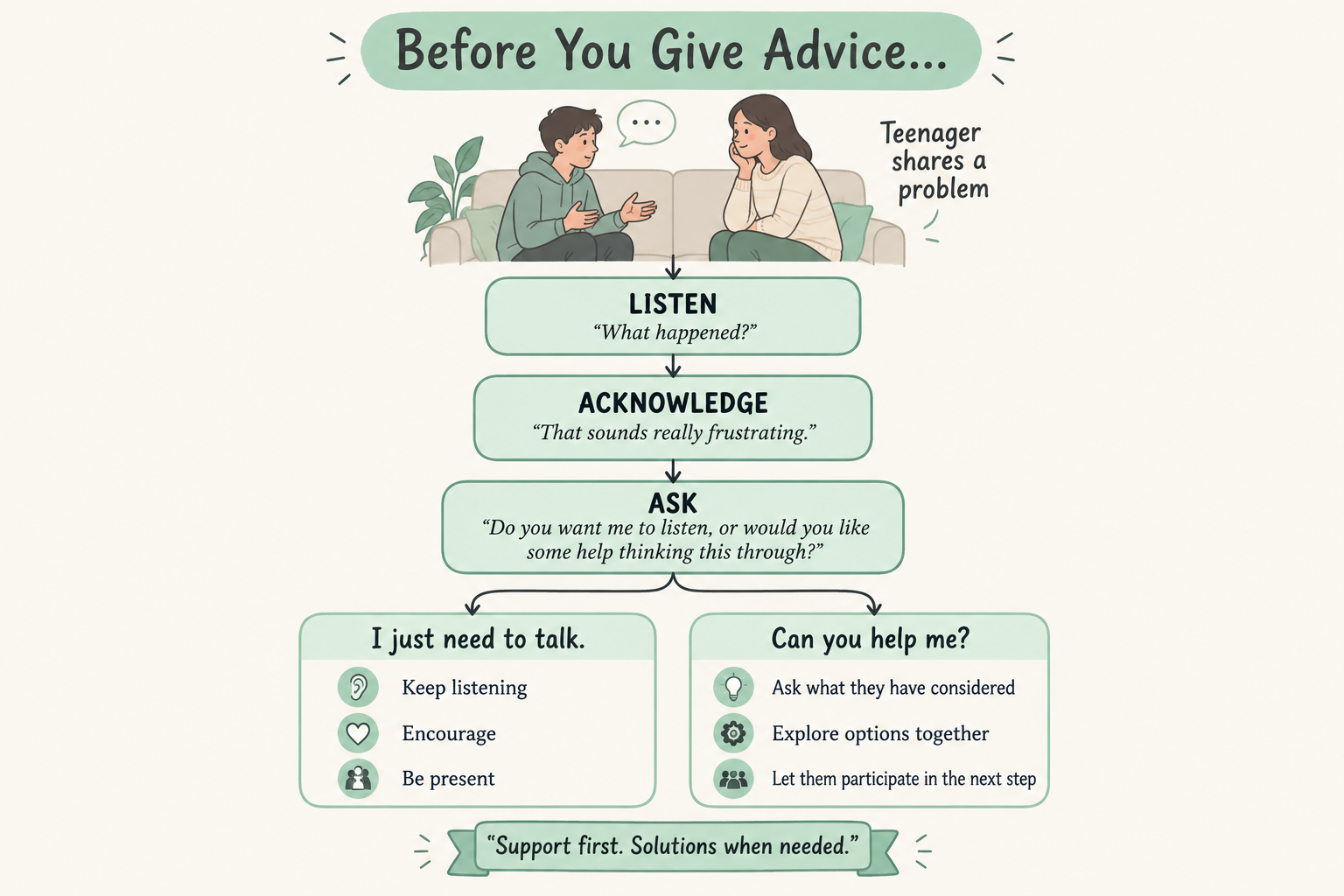
The diagram at the top of this article is the sequence I now follow, both with students and at home. It is deliberately simple, because in the heat of a difficult moment nobody can run a complicated protocol:
Before you give advice
Listen: let them finish. No interruptions, no corrections, no "well actually". Silence is allowed. It is not wasted time; it is thinking time.
Acknowledge: name what you heard and the feeling in it. "That sounds really frustrating." "No wonder you're upset." You are not agreeing with everything; you are showing the feeling registered.
Ask: "Do you want ideas, or do you just want to vent?" This one question changes everything, because it hands control of the conversation to them.
Then decide: if they want to vent, keep listening and stay present. If they ask for ideas, explore solutions together, their ideas first, yours second.
That Ask question is the hinge. Most of the time, a teenager will say "just listen". Occasionally they will say "actually, can you help me...", and at that moment, the advice you have been holding back finally lands, because it was requested. Advice given before it is asked for is interference. Advice asked for is help.
Support first. Solutions when needed, and ideally, when asked.
What listening actually sounds like
Knowing you should listen and knowing what to say are different skills. Phrases that keep the door open:
- "That sounds really unfair."
- "I can see why that upset you."
- "Tell me more about that."
- "That's a tough spot to be in."
- "Do you want ideas, or do you just want to talk it out?"
And phrases that close it, no matter how well meant:
- "You should have..."
- "Why didn't you...?"
- "When I was your age..."
- "It's not a big deal, don't overthink."
- "I told you so."
Notice that none of the open-door phrases solve anything. That is the point. Their job is to keep the channel open so that help, when your teenager finally wants it, can travel through.
When solutions do help
None of this means solutions are bad. It means timing decides whether they are received or rejected. A teenager who feels heard will often arrive at the solution themselves, and a solution they generate sticks far better than one handed to them. When they do want help with schoolwork, the same principle applies: before adding more practice, work out what is actually missing: the difference between task completion and real learning, which I explain in why "read more books" and "do more math questions" may not be enough.
How this shows up in our classrooms
In our small-group classes I watch this play out every week. A Secondary 4 student, a few months before the O Levels, says quietly: "I'm scared I'll run out of time in the paper." What does that student need first? Not yet a study plan. They need the fear said out loud, and heard. Only once it is out in the open does the practical work land: the pacing drills and full-paper practice we build in, which I describe in how students can build exam stamina for O-Level Math.
Small groups make this possible in a way lecture-style teaching cannot. With four to eight students, there is space for a teenager to say what is actually on their mind, and for a teacher to catch it, listen, and then turn it into a plan. Parents tell us this is one of the things they value most; you can read their experiences in our parent reviews.
If exam pressure has made conversations at home difficult, you do not have to carry it alone. You can view our class schedule or WhatsApp us at 8166 1212. We are happy to talk through your child's situation first, before suggesting anything.
Frequently Asked Questions
My teenager barely talks to me at all. How do I even start?
Start small and in low-pressure moments: car rides, meals, walks. Ask one open question, tolerate the silence, and do not turn it into an interrogation. Consistency matters more than intensity. A teenager decides whether the channel is safe based on what happens over weeks, not one big conversation.
What if I can see my teenager is about to make a mistake?
Ask permission before advising: "Can I share one thought?" If they say no, note it and revisit later, when they are calmer. The relationship is the channel through which your guidance travels, and protecting it usually gets your advice through faster than delivering it immediately.
Is listening without giving advice the same as agreeing with them?
No. Acknowledging a feeling is not endorsing a choice. "I can see why that upset you" does not mean "you were right to do that." Teenagers who feel heard are far more willing to accept correction and guidance afterwards.
How does this relate to exam stress?
Exam pressure is one of the biggest triggers for teenagers shutting down. Many will not admit they are anxious, so naming it gently, "you seem stressed about the paper", often opens the conversation. Once the fear is out in the open, practical help like timed practice and a pacing plan actually gets through.
Want personalised guidance for your child?
Every student learns differently. At AZKEN, Mr Ken Lim designs personalised learning plans that address your child's specific needs and goals.
Mr Ken Lim
Founder & Lead Educator, AZKEN
- Teaching Mathematics & Science since 2010
- Founder of AZKEN
- Primary Science, Primary Mathematics and Secondary Mathematics educator
With over a decade of experience teaching Science and Mathematics in Singapore, Mr Ken Lim has helped hundreds of students build confidence and achieve their academic goals. He believes every child can excel with the right guidance and encouragement.